Start of Belgium’s first Hydrogen Valley with FLHyPorts project

The transition to renewable energy isn’t just an engineering challenge. It is fundamentally and economic one. Today, the FLHyPorts (Flanders Hydrogen Ports) consortium officially kicked off to establish Belgium’s fist Hydrogen Valley.

By connecting the ports of Antwerp-Bruges, Oostende, and North Sea Port, the project will demonstrate how green hydrogen can practically decarbonize logistics, heavy industry, and inland shipping.

Representing the University of Antwerp, my focus is on the economic reality of making this transition viable. Throughout the project, I will be working on the economic analysis to evaluate the true financial footprint of these technologies, which will include:

  • Cost Simulations: Benchmarking the real-world business costs of hydrogen-powered solutions against conventional alternatives.
  • Socio-Economic Cost-Benefit Analysis: Quantifying both the private and the broader societal costs of adopting these hydrogen innovations.
  • Life-Cycle Cost Assessment: Evaluating the entire lifespan of the technologies, tracking financial impacts from raw material extraction all the way through to final disposal.
  • Market Scaling & Replication: Forecasting future market demand and technology adoption rates to assess exactly how these solutions can be scaled across other European hubs.

FLHyPorts is targeting over 1 800 tonnes of annual green hydrogen consumption by 2030, alongside the development of a practical replication toolkit for Europe. I’m looking forward to investigating the economics of these innovations to identify how to turn these targets into a scalable market reality.

You can follow the project updates on the official FLHyPorts page.

Market readiness analysis: Expected uptake of alternative fuel heavy-duty vehicles until 2030

A report I had the privilege of contributing to has now been published! It’s titled “Market readiness analysis – Expected uptake of alternative fuel heavy-duty vehicles until 2030 and their corresponding infrastructure needs”.

The report investigates the future of heavy-duty vehicles, looking at how we can shift to alternative fuels to meet our 2030 emission reduction targets. We explored everything from the market readiness of vehicles and infrastructure needs to support them to the existing barriers. It’s a topic I’m passionate about, and I’m proud of the work we’ve done.

Working on this project together with Ramboll and TMLeuven has been a fantastic experience.

You can find the full report here: Market readiness analysis – Expected uptake of alternative fuel heavy-duty vehicles until 2030 and their corresponding infrastructure needs

Article “Economic Impacts of the ERS Implementation on Rotterdam-Antwerp Corridor” on Preprints

The process of publishing an academic paper can be long, as it usually goes through several review cycles. This takes a lot of time. Having the results of my work public, however, has certain benefits.

We are currently in the process of publishing a new paper on Electric Road Systems, and have therefore chosen to use Preprints for the first time. It allows making the work public the next day after submittig to the journal.

Our paper “Economic Impacts of the Electric Road System Implementation on Rotterdam-Antwerp Corridor” investigates the potential impacts of implementing the different ERS technologies on the Rotterdam-Antwerp motorway corridor that links the two largest ports in Europe. The aim is to identify which of the routes between the ports is best suited for implementation of ERS, whether there are substantial differences in economic performance of the different ERS technologies, see what ERS vehicle traffic volumes are required and potentially available for successful implementation, what investment is required to build the system and whether the ERS operator can be profitable, and could transport operators operate their trucks on ERS profitability in this corridor setting. 

The Preprints article is available here: https://doi.org/10.20944/preprints202407.0843.v1

10th International Workshop on Sustainable Road Freight

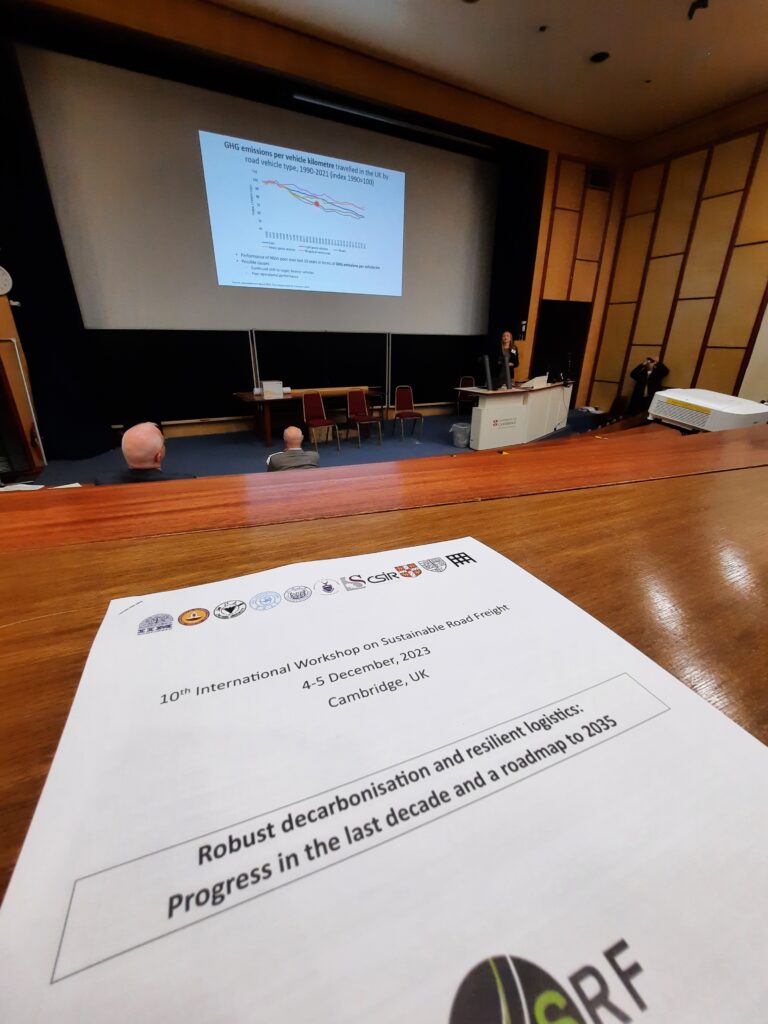
This week I participated in the 10th International Workshop on Sustainable Road Freight in Cambridge, UK.

I presented the research I am currently working on implementation of Electric Road Systems on the Rotterdam-Antwerp road corridor. I got positive comments and constructive inputs from the audience.

I thoroughly enjoyed the workshop sessions I participated in. It was nice to see the diverse research undertaken by others.

The workshop programme is available here.

Flanders to subsidise 1200 charging points for electric trucks

Companies in Flanders are now receiving subsidies from regional authorities to set up new charging stations for electric trucks. This initiative, which began at the start of the year, allows Flanders-based businesses to seek reimbursement for 20% of their investment, with a maximum cap of €300,000 per company.

https://www.brusselstimes.com/belgium/667995/flanders-to-subsidise-1200-charging-points-for-e-trucks

Electric cars catch fire much less often than fossil fuel cars

The claim that electric cars are dangerous due to a high fire risk is often put forward by opponents of electric cars. But according to the Swedish Civil Contingencies Agency (MSB), gasoline or diesel-powered cars are 19 times more likely to catch fire compared to electric or plug-in hybrid cars.

In 2022, only 24 electric or plug-in hybrid cars caught fire in Sweden, which accounted for approximately 0.004 percent of all such vehicles in the country. On the other hand, around 0.08 percent of fossil fuel-driven cars caught fire. The number of fires in electric cars has remained consistent at around 20 per year for the past three years, despite a nearly doubled number of electric cars in Sweden, totaling nearly 611,000. The MSB includes trucks and buses in their compilation, noting that the majority of these vehicles are still diesel-powered.

https://www.msb.se/sv/aktuellt/nyheter/2023/maj/brander-i-eltransportmedel-under-2022/

Economic impacts of the catenary electric road system implementation in Flanders

I am excited to announce the publication of our research paper titled “Economic impacts of the catenary electric road system implementation in Flanders” in the International Journal of Sustainable Transportation, that we wrote together with Thierry Vanelslander.

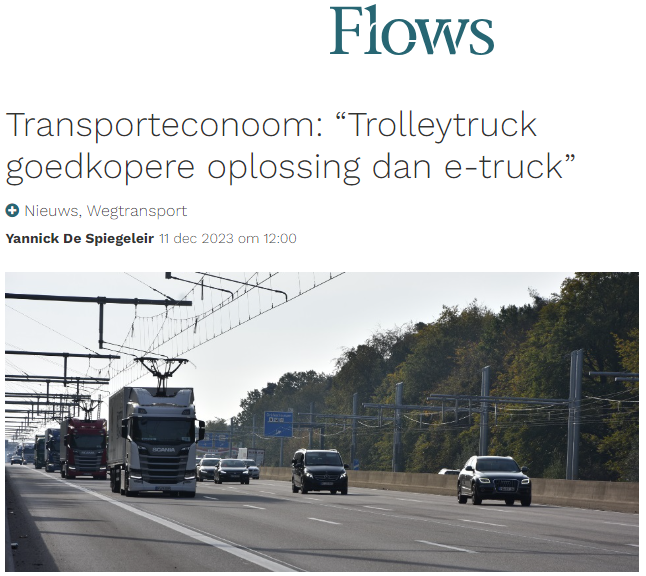
Our paper explores the deployment of catenary electric road systems (ERS) on the Flemish road network in Belgium. We investigate the economic impacts of implementing this technology on the road haulage industry, their clients, and wider society under different technology adoption scenarios. We also identify the most optimal way of building a catenary network in Flanders and potential synergies that could come from implementing ERS in neighboring countries.

The findings show that catenary ERS has the potential to be developed into an economically sustainable and relatively cheap way of decarbonizing road freight transport. It offers considerable economic incentives for all involved stakeholders and is beneficial to society as a whole.

I would like to express our sincere appreciation to all who provided invaluable assistance, advice and support throughout this research: Aldo PeetersSophie DelannoyToon WassenbergPatrik ÅkermanArjan van VlietKlaas Van Cauwenberg, and many others.

To learn more about our research, please follow the link to the full paper:

https://www.tandfonline.com/doi/full/10.1080/15568318.2023.2197865
Logibat closing event

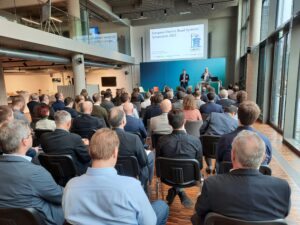
The Logibat project’s closing event will be held on April 20, 2023, at Log!Ville in Niel. The project aimed to evaluate the current state and future developments of battery-electric trucks, as well as identifying the challenges that must be addressed for a wider roll-out. At the event various models of electric trucks and charging equipment will be showcased, providing attendees with an opportunity to learn more about the latest technologies in the industry.
My contribution to the project was with the research on Electric Road Systems (ERS), important because ERS has the potential to reduce carbon emissions, increase the adoption rate of electric freight vehicles, improve air quality and improve the cost performance of road freight transport.

DISCLAIMER: All views expressed on this site are my own and do not represent the opinions of any entity whatsoever with which I have been, am now, or will be affiliated.